 English
  Türkçe
What is Loadcell? How does it work? What are the types?
What is Loadcell? How does it work? What are the types?
( Load Cell ) , It works using a combination of Wheatstone bridge equation and strain gauge. The Wheatstone bridge equation is the basis of the loadcell, developed by Samuel Hunter Christie in 1833 and Sir Charles Wheatstone in 1843. Today, load cells usually consist of four strain gauges in a Wheatstone configuration.
Before strain gauges, people carried out industrial weighing applications with mechanical lift scales.
Later, both hydraulic and pneumatic force sensors were preferred. As we mentioned, the Wheatstone bridge equation was invented in the mid-1800s, but it didn't take until the mid-1900s to combine it with a strain gauge to make effective load cells.
The first bonded resistance wire strain gauge was developed in the 1940s. Years later, as modern electronics developed, load cells became both technically and economically viable.
Finally, Dr. Hans-Joachim Henss developed the first load cell in 1967 and brought the name load cell to the society. So what exactly is a Load Cell? How does it work and what does it do? Let's examine together.
What is a Load Cell?
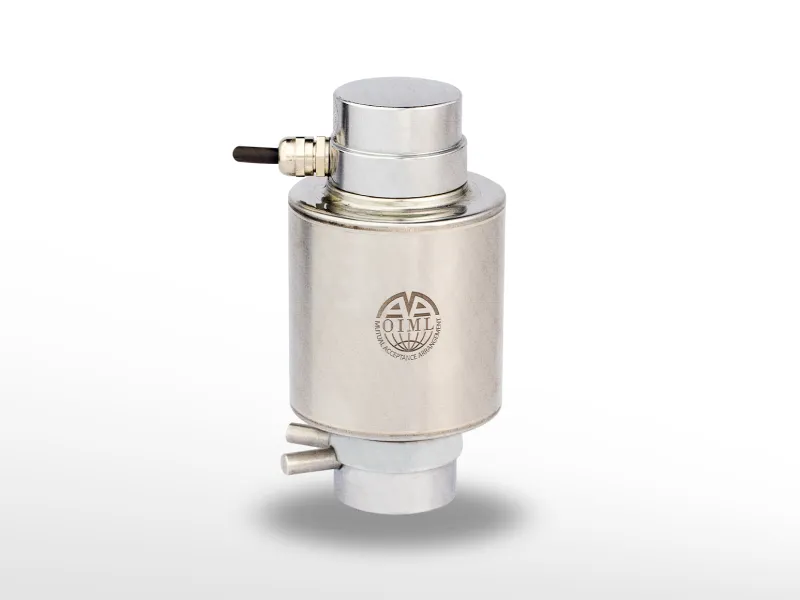
A loadcell or load cell is, by definition, a type of converter. But it is more commonly known as a force transducer.
It converts a mechanical force such as load, weight (also known as weight sensors), tension, compression, or pressure to another physical variable, in this case an electrical output signal that can be measured, converted, and standardized.
As the force applied to the force sensor increases, the electrical signal changes proportionally. In other words, load cells are special sensors that convert the force or mass applied to that sensor into a readable signal via an electronic circuit. It mostly works over the Wheatstone bridge. The output signal can be displayed in 'weight' or 'force' after linearization and scaling via a weighing amplifier or weighing indicator.
Where Are Load Cells Used?
The application of load cells is versatile. Simple personal scales in your bathroom, for example, work on this principle.
An example of this is force sensors incorporated into heavy construction structures such as bridges and viaducts, or force transducers in hydraulic pressure transmitters. The sensors in the hydraulic pressure transmitters also measure the force exerted by the fluid against a diaphragm in the pressure sensor. Many applications of force transducers include fixed and permanent assemblies, such as silos or scales, where pressure boxes are usually placed under feet. These pressure boxes, also called load cells, are usually connected in series and the sum of the outputs from the pressure boxes can be converted to the total weight of the silo, the contents of which rest on the load cells.
Force transducers are a staple in many industries where reliable, highly accurate load measurement is paramount, such as automotive, high-precision manufacturing, aerospace and defense, industrial automation, medical and pharmaceutical, and robotics. Recently, collaborative robots (Cobots) and with developments in surgical robotics play an important role in many new force measurement applications such as miniature medical sensors. It is also frequently preferred in areas such as built-in scales, smart shopping trolleys, shelf weighing in supermarkets, overload protection in elevators and cranes, silo management, autonomous mobile robots, egg weighing machines, real-time stock, beehive monitoring.
What is the Working Principle of Load cell ?

In order to understand the load cell operating logic, first of all, it is necessary to deal with the physics and materials science behind the strain gauge, which is the load cell operating principle.
Metal foil strain gauges are a material whose electrical resistance varies with the strain or compression applied to the strain gauge. The strain gauge is applied to a metal body where force is applied.
The metal body is deformed, which causes the strain gauge to stretch or compress as it is very tightly adhered to the metal body with a special adhesive.
So the strain gauge can measure residual force, pressure, tension, compression, torque, weight etc. converts it into a change in electrical resistance and makes it measurable. Therefore, metal foil strain gauges are the basis of the working principle of the force sensor.
Strain gauges are electrical conductors tightly attached to a film in a zigzag pattern. When this film is drawn, the conductors are elongated.
When pushed, it contracts and shortens. Due to this change in shape, the resistance in electrical conductors also changes. Since the resistance of the strain gauge increases with applied voltage and decreases with contraction, the voltage applied to the load cell can be determined according to this principle.
How Load Cell Works ?
Strain gauges work on the Wheatstone Bridge principle.
Most load cells come with a calibration report showing the output in mV. The sensor is supplied with a DC voltage from the measuring amplifier, followed by an output expressed as xx mV at no load.
Load cells usually have an output in mV/V. The higher the output, the more accurate the strain gauge, that is, the load cell.
If you then load the load cell with a known value, you will get a second higher output than the no-load value.
You can now "scale" the correct value on a good metering amplifier and save it in the amplifier, specifying the no-load value as zero (0) on your meter amp and the highest value of known force or weight. In this way, it is possible to perform a 2-point calibration.
In applications such as high precision factory automation, surgical robotics, aerospace and load cells, linearity of loadcell dimensions is very important to accurately feed the PLC or DAQ control system with precision force measurement.
What are the Loadcell Types?
Bonded strain gauge load cells are the most commonly used type when it comes to Strength and Sensitivity. Loadcell variants are also used to measure other forces such as frequency, torque, compression or pressure. However, when categorized, hydraulic, piezodynamic, pneumatic, optical, elastomer load cells are available. All load cell types are:
- Overload Control Load Cell - Used in dynamic, static or buoyancy measurement applications.
- Thrust Load Cells - Used in applications requiring low mounting height and high precision. Large forces ranging from 1-500 tons.
- Double Blade Type - Mobile Vehicle Weighing is used in tanks and weighing bunkers.
- Multi-Axis Load Cells - Multi-axis load cells are used when the force in more than one vector axis needs to be measured.
- Strain Sensors - Tension Type Loadcell are load cells that measure the tension of the rolls in the winding and unloading reels.
- Articulated Type Load Cell - Articulated type Loadcell are load cells with spring equipment that flex slightly when exposed to a force or weight.
- Flat Type Load Cell - Flat Type Loadcell are load cells that measure with their structures that bend slightly when subjected to a force.
- Pin Type Load Cells (Load Pin) - High precision load cells used in mobile weighing applications and crane overload control systems.
- S Type Load Cell - S type load cell is a load cell used for measuring compressive and tensile forces.
- Mobile Type Feed Mixed Load Cell - Loadpin Load cell is a load cell with models that can be used in animal scales and mobile weighing systems.
Irrespective of the types of load cells, each one has basic features. The different specifications and features are as follows:
- Material; alloy steel, aluminum or stainless steel sensors.
- Load cell capacity; 20 grams to 1000 tons
- Load cell accuracy; C3, C4, C5, C6
- Agreements; OIML, NTEP, Gost, FM, ATEX
- Degree of protection (IP value); IP64, IP65, IP66, IP67, IP68, IP69K
What are the Benefits of Strain Gauge Based Load Cells?
Strain gauges are the most widely used technology given their high accuracy, long-term reliability, variety of shapes and sensor geometry, and cost-effectiveness compared to other force measurement technologies. Also, sensors used to evaluate strain gauges are less affected by temperature fluctuations. Other benefits can be listed as follows:
- Provides the highest accuracy to meet many standards, from surgical robots to aviation.
- It has a solid construction made of stainless steel or aluminum with high resistance and little deflection.
- It shows high performance and long life even under the toughest conditions. Some load cell designs can reach billions of full cycles (lives).
- Many geometries and custom shapes are available, as well as mounting options for any scale and virtually any location.
- Although the price of Loadcell varies according to measurement precision and usage areas, it has budget-friendly alternatives thanks to its affordable price ranges.
What Should Be Considered While Choosing Loadcell?
Strain gauges are the most widely used technology given their high accuracy, long-term reliability, variety of shapes and sensor geometry, and cost-effectiveness compared to other force measurement technologies. Also, sensors used to evaluate strain gauges are less affected by temperature fluctuations. Other benefits can be listed as follows:
- Provides the highest accuracy to meet many standards, from surgical robots to aviation.
- It has a solid construction made of stainless steel or aluminum with high resistance and little deflection.
- It shows high performance and long life even under the toughest conditions. Some load cell designs can reach billions of full cycles (lives).
- Many geometries and custom shapes are available, as well as mounting options for any scale and virtually any location.
- Although the price of the Load Cell varies according to the measurement accuracy and usage areas, it has budget-friendly alternatives thanks to its affordable price ranges.
What is Loadcell Module ?
Load cell module( Transmitter ) it is known as. The value in mV/V received from the Transmitter Load Cell 0-10/4-20 - CanBus - Modbus - Profibus - Profinet communication such as into protocols..
What to Consider While Choosing a Load Cell?
When choosing a loadcell, first of all, the usage area should be clearly known.
- Accuracy Class
- Material Quality
- Continuity and Linearity
- Capacity
- Verification and Test Methods
- Environmental Conditions
Weilo offers quality and functionality together by producing 100% domestic load cells as well as various electronic and mechanical weighing systems. If you want to benefit from Weilo products and solutions, you can take a look at our services.